
by Rhonda Sheryl Lipstein | Mar 30, 2012 | Namaste Love Whispers
Words, words, words….
I AM often tickled by others for my “seriousness or playFullness” 😉 regarding words.
“Why so serious or playFull?
Why ALL the ‘special attention’ to words??” they ask.
Spoken Language IS one of our MAIN means of CONSCIOUSLY communicating with ONE another.
That means pretty much all that we intend, everything that we feel, think, desire, [or don’t]- all that we require to BE within this world is transmitted/communicated using WORDS.
THINK BEfore you speak.
CHOOSE your words wisely.
BE Authentic with your speech ?that you may ‘stand by’ what you have said, transmitted, and utilized to represent you.
Granted, we communicate on a multitude of levels with ONE another……most of which are unseen subtle levels, some of which are silent but very visible, like body language for example.
What we have BEen taught however IS to pay attention most to those levels of communication that are the most obvious as opposed to those that are the most subtle, [which is where the magic really takes place] the main ONE BEing our use of verbally expressed language, which as many can attest DOes NOT allways communicate our truth. In fact, often times, it is due to verbal miscommunications that we find ourselves in the middle of disagreements with those we hold the most dear to us.
ALL levels of communication should BE given the gift of our Conscious Awareness, something of course we need to retrain ourselves to pay attention to, in that we have been so very well trained to pay attention to only those that are the most obvious.
All levels of communication should BE expressions of Authenticity, ensuring we are DOing what we are able to so DO to express our Truth whilst taking into consideration the individual to whom we are so expressing it to, and thus CHOOSing expressions that are of LOVE. ***
ThankFully, life IS an ever growing, expanding, transcending, evolving, learning experience and together we are redirecting our attentions to consciously and authentically communicate on all levels of our multi-dimensional BEingness with ONE another, starting of course by so DOing WHOLEistically withIN our own internal SELF communications. 😀
**Here’s a little ACTivity that can assist each of we assist ONE another in this new paradigm shift into communication consciously. 😀
For the next 24 hours CHOOSE to pay attention to your SELF and how you are communicating.
Follow this 24 hours period by another 24 hours in which you expand your awareness to pay attention to both yourself and ALL others with whom you communicate.
**When paying attention, look WHOLEistically. In other words, look not only to the verbal communication of self or others but to their/your WHOLEistic communication, from that which is seen to that which is subtle and unseen.
At the end of each 24 hours period, write about your experience and what you noticed.
Then if you are feeling blissFully inspired, come back here and share in your observations.
And finally, repeat often. 😀
Blissedly BE
Radiating LOVE
Roni*
by Rhonda Sheryl Lipstein | Mar 28, 2012 | Namaste Love Whispers
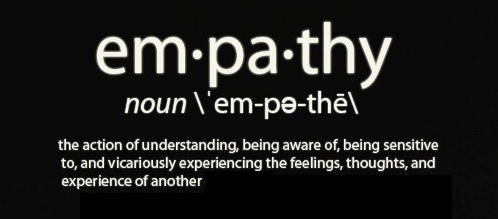
We are by nature an empathetic and compassionate species.
In other words, we intuitively feel another’s emotions, [ie: great passion, pain, joy, saddness, love, etc…] by simply BEing in AWAREness of what another IS going through….not ever having our selves to go through it.
A perfect example is when we go to the movies.
We don’t have to have ever been in a car chase, or had our lives threatened by mutant ninja turtles, flew though the air on a huge dog dragon or battled for the very existence of earth itself to feel the thrust of emotions wave through our beingness that we are watching displayed on the big screen.
Indeed, in our own lives, when we hear of something amazing or tragic happening to another, we need not ourselves be involved to “feel for” those that are.
Compassion and empathy are built in to our inherent make up as human BEings.
Thus, with respect to the commonly held notion that we “need to experience bad things or suffering to know, appreciate, and have gratitude for the good” I say a resounding, NAY.
*What we ‘need’ IS to BE educated, informed and made aware of ONE another and the plethora of lifestyles, and living conditions that exist upon our planet.
*What we ‘need’ is to be conditioned/trained/socialized/raised to foster our inherent gratitude and appreciation for the BEaYOUty and Divinity that IS ALL the Gifts we are BLISSed with….to BE naturally LOOKing for and thus appreciating the “good” that IS.
*What we ‘need’ is to foster into our rote conscious awareness and thus manifest ACTions our inherent KNOWing of the WHOLEistic Unity of our existence to and with one another and ALL that is, ever was or will BE. To foster an understanding that each and every ONE of we DOes make a difference, DOes have an affect upon the rest of the whole that is ALL and thus to BE response – able for our thoughts, feelings and ACTions.
A matter of perception……of aligning the mind withIN the heart of unconditional LOVE.
A matter of perception that makes all the difference in the world to what it is we define to be our world, our role in it and the very experience we have thereof.
Wanna change the world?
Change your perception.
Blissedly BE
Radiating LOVE,
Roni*
by Rhonda Sheryl Lipstein | Mar 22, 2012 | Namaste Love Whispers
originally posted on Ram Giri’s website: Skills for Awakening
The ego is confusing. It’s not your enemy. And you already know that very often it isn’t your friend. It can cause a lot of trouble.
If you have too much of it, you may be blind to it—while it’s obvious to everyone else. If you have too little, you can’t function in this world.
You can’t live without an ego; you have to have one, but it isn’t real. It is created moment to moment by a conversation you have in your head: one moment you’re wonderful, the next moment you shiver in fear.
This ego, the one that’s forever busy chasing what it desires and protecting itself from what it fears, is the ego of suffering.
The ego is baffling and mystifying, and if you don’t understand it, and educate it, it will be your master, instead of the servant it is meant to be. Then it will lead you around by the nose, through a lot of pain and loss to exactly nowhere.
You’ve heard all the stuff about transcending, or even ‘killing the ego.’ And you’ve also heard that you need ‘ego strengths.’ So what is it? Do we need to get over it, or make it strong?
The answer is: both. You think that’s paradoxical? Definitely!
Okay, lets start with the basics.
At birth you emerge into this world from what has been called “The Ground of Being,” the womb of the universe. And at death, that’s where you go. It is the Self, the alpha and the omega, spirit, THAT which many people call God.
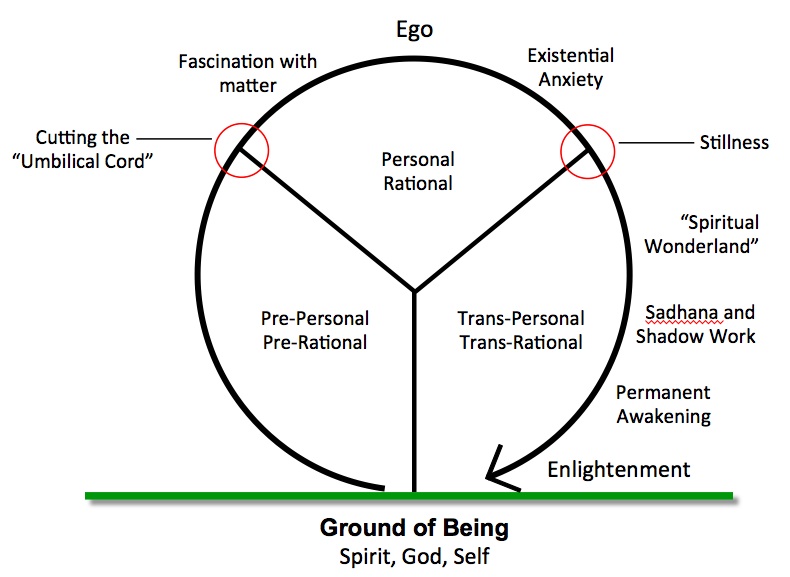
From there you can picture the journey of your existence as a circle that begins and ends in the Ground of Being.[1]
You can then divide this circle into two halves. The first part of life is about building the ego, coming to know who you are in this short time-span of your existence; it’s about going out into the world, about self-assertion, about being some body. The second half is about returning back home to our essence, to your origins, to spirit, to Self-realization, to eternity, oneness, and truth.
The “I” changes throughout this circular journey.
[1] I’m borrowing here from the work of Ken Wilber in ‘The Atman Project’

We can also divide the circle into three parts, three pie shapes. In childhood the ego begins as soon as you start to think. At the beginning of thought there is a mechanism that makes you continuously relate everything in your world to this “I.” You make up this thing called “I” as you think. You believe it’s a stable ‘thing,’ but it isn’t; it’s like an optical illusion of the mind that appears real.
This first third of the journey is the pre-personal stage. The roots of your beliefs of “I am………” are laid here, good and bad. You identify with your body, your likes and dislikes, your emotional habits and your personal history. You praise yourself and experience pride, and you condemn yourself and experience guilt. Most of this is subconscious and quite automatic. You struggle to be who you think you are meant to be, and you judge yourself as to how well you think you are doing. This, as I said, is the ego of suffering.
At this stage you are unconsciously still fused with the collective mind, and your thinking is deeply conditioned. You think in the way your family or clan, religion or nation told you to think. You are under the influence of an internalized voice that sounds like a controlling and critical parent. You have not yet developed a fully independent sense of yourself, a free way to make up your own mind.
For that you have to cut the restricting ‘umbilical cords’ that bind you to the ways of your upbringing. Until you do, you do not yet have a fully functioning ego. You’re part of the group mind. You’re also still close to spirit and that gives you comfort. But the danger here is that you may be prone to fundamentalist thinking.
Once you cut the ‘umbilical cord’, you move into the self-conscious stage, become a fully rational person and see the blossoming of your personal identity. You become an independently functioning individual, a “person” in your own right. No longer bound by the fear of being rejected by your group if you were to be fully yourself, you unfold your unique gifts and abilities.
This is the culmination of what Western psychology calls the development of ego-strengths. Rational and relatively independent in your views, you act and operate in your world.
Western culture generally assumes that this is the totality and aim of human development. Once you are a strong individual, you ‘have made it’ in the eyes of our culture; you are done. Therefore, of course, most individuals do not evolve much beyond this point. They are still in the grip of the ego of suffering, and remain far removed from the nurturing reality of the true Self.
This is now changing, as more and more of us realize that the highly developed ego is not the end of the line. And the ego itself feels it, as it matures. Where it has been fascinated with material life at first, now a sense of unease arises, an existential loneliness, disconnection and lack of fulfillment, or perhaps a deep, but indistinct yearning. These can easily turn into despair and trigger addictions and relationship problems.
Such lack of fulfillment is often mistaken for regular anxiety or depression—but that is not what it is, and it should not be treated that way. The ego has to suffer this basic lack of fulfillment, because it knows deep down that it, along with the body and all its worldly achievements, is going to die—although it tries hard to ignore that fact.
But rather than despair, this is the time when the individual needs to evolve further, and only entry into the next stage, the spiritual stage of development can resolve these problems.
This brings us to the third pie shape, the trans-personal stage. This part of the journey has been deeply studied by the world’s mystical traditions. Particularly Indian Vedanta and Tibetan Buddhism have elevated this inquiry to a profound and fascinating science.
As long as you operate exclusively through your rational mind, you will remain unaware of the reality of this higher development, because it goes beyond the ego, beyond the rational mind. But it does not deny rationality; it includes and transcends it. Here the mind can evolve into intuitive intellect and into divine intelligence.
It begins with experiences that lead you into the spiritual realm. At first these moments of peace, or deep joy, or your ability to perceive a deeper truth, are fleeting. To make them more permanent, you must develop an ability for stillness. Meditation is the best known and time-honored way to do that.
The first part of the spiritual journey is the exploration of ‘spiritual wonderland.’ You are fascinated by all kinds of exciting options, collect spiritual paraphernalia, move from teacher to teacher, read many books, and, all-in-all develop a very cool spiritual ego, which is not much different at all from the rational ego. It feels special about itself, either in a good or bad way, and in that it is absolutely commonplace.
But as you explore the spiritual realm, you build another kind of ego, the ego of aspiration. Now you feel drawn to real sadhana, to committed spiritual practice.This is how you can free yourself of the shadow elements, the habits of suffering which you have acquired earlier in life and which are the true source of your pain.
The higher reaches of spiritual realization will remain hidden to you until you do this work. But with the gradual easing of unconscious tensions, and with a greater and stable peace, comes the ability to look inward.
Now a great paradigm shift begins. You realize that who or what you thought you were was in fact a mistaken identity. Yes, the ego was useful enough for a while, just like the countless other identities you have built in past lives that are now gone and forgotten. And so will this one be gone in just a few years.
Now however this is not a source of despair, but of a great aspiration. You begin to intuit that you are in truth not this puny ego with its ongoing drama and self-importance, but the true Self, and your body and mind can serve as the perfect expression of divine presence in form.
You realize that you are not the body, but a ray of divine light that is reflected in you. And, going even further, you realize that this individual ray is one with the sun, the Self, the Source of infinite light.
In the expansion of this inner experience, the ego is transformed into the ego of the sage. Where it has formerly been opaque and confused, it now becomes transparent to the light. Where it has been a dictator, if not a tyrant at times, it now becomes your faithful and reliable servant.
Through the force of continued spiritual practice, sadhana, your being becomes the conduit of divine grace. The thinking mind with its judgments and stress dissolves and gives way to the intuitive intellect, which can run your worldly affairs perfectly.
The heart remains increasingly open and, since you are internally filled by the bliss of the Self, you can love freely. Your life becomes a life of joyful service to all beings around you, in whom you recognize the same presence of God that shines in you.
This is the way to absolute peace and to the fulfillment that does not die when the body is done. It is the realization of your true and immortal identity as the Self.
The ego evolves from being the source of much trouble to being a clear lens through which the presence of God shines into this world. How is it done? What are the mechanisms that are at work in this transformation? And what is the most crucial transformation from the ego of aspiration to the ego of the sage? That is what we will discuss in Part 2.
We invite you to watch the video: The 3 Aspects of Ego by Ram Giri.
For more information visit our website www.Skillsforawakening.com
With love and gratitude,
Ram Giri
and the Skills for Awakening Team